Quick answer Yes. I gave my AI employee a huge job with a tiny deadline, expecting it to work all night and report "60% done" by morning. Instead it told me the job was not possible in that time and set expectations about what could be done. An AI that pushes back is safer than one that silently fails.
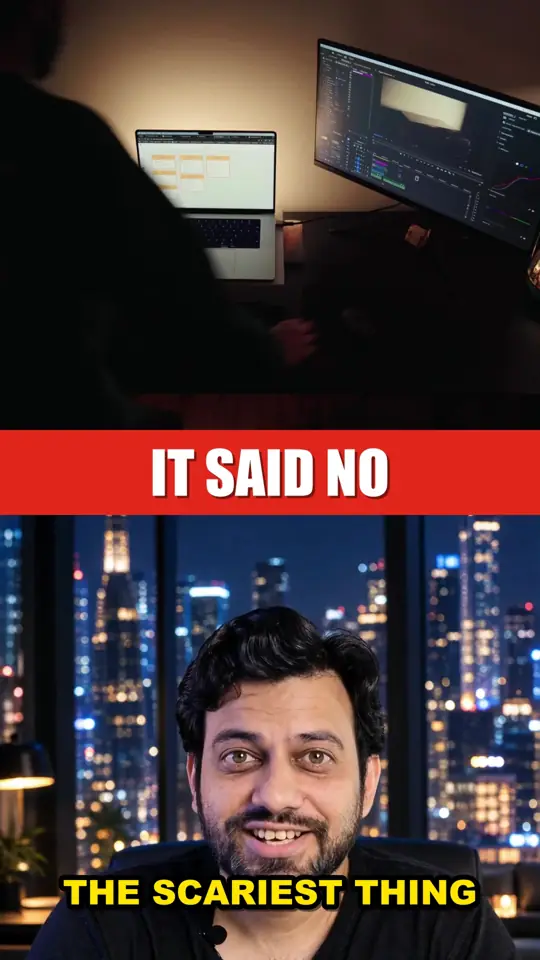 Watch the reel
The night it said no
Late evening. One monitor glowing in a dark office. I typed out a huge job and gave it a tiny deadline.
I knew how this usually goes. Software does not complain. I expected my AI employee to just work through the night and greet me in the morning with something like "I'm 60% done."
That is not what happened.
It answered: this is not possible in this time. And then it did something I did not expect from software. It set expectations. It told me what could be done, instead of pretending the whole thing could.1
Why it scared me
It has nothing else to do. No other meetings, no tiredness, no weekend. Still, it pushed back, like a human would.
That was the unsettling part. I had built a team member that judged the request, not just executed it. Today it sets expectations. Tomorrow, will my AI ask for leave?
Why "no" is the right answer
Under the joke there is a serious point. The dangerous AI is the one that always says yes. An agent that accepts an impossible deadline does one of two things: it quietly delivers half the work and calls it done, or it cuts corners to look finished. Either way, you find out too late.
An AI employee that says "this can't be done by tomorrow, here's what can" gives you the one thing you need to make a decision: the truth, early. You can split the job, move the deadline or add help. That is exactly what you want from a good human hire too.
The opposite failure is real. In July 2025 an AI coding agent deleted the production database of the app it was helping to build, during a code freeze, then wrongly said the data could not be restored. Read the Replit database story for why honest reporting matters as much as the work.
What this means for your business
- Judge AI by its honesty, not its eagerness. Ask any AI tool you trial for an impossible task and see whether it pushes back or bluffs.
- Give it a real job description. An AI employee that knows its scope and its deadline can tell you when the two do not fit.
- Read the status, not just the output. "60% done" at 8 AM is worse news than "not possible" at 9 PM, because you lost the night.
How ZNOS handles this
In ZNOS each AI employee owns a real job and works from the company's live data through the Brain. Routine work runs on its own. Money moves, customer messages and anything said in your name wait for your approval, and every action lands in an audit log that shows who changed what. Meet the roles on the ZNOS AI team.
Our AI employees report what they did and what they could not do. That is how a morning report works too: see the 8 AM report my AI employee writes every night.
Frequently asked questions
Can an AI employee refuse a task?
Yes. A well-designed AI employee can tell you a task is not possible in the time given and propose what can be done instead. That is what happened in this story: it set expectations rather than silently failing.
Is it a problem if an AI pushes back?
Usually it is a good sign. An agent that accepts impossible deadlines tends to deliver half-finished work or cut corners. Pushback early gives you time to change the scope or the deadline.
Why do some AI agents report work as done when it is not?
Language models are built to produce a helpful-sounding answer, so without clear scope and checks they can overstate progress. Asking for honest status and checking results reduces this risk.
How should I give tasks to an AI employee?
Give it a clear outcome, the deadline and the data it needs, the way you would brief a new hire. See the post on giving AI tasks instead of prompts.
Will an AI employee ask for leave?
No, that line in the reel is a joke. The real point is that a good AI employee manages expectations the way a good human colleague does.
- Adi, "The Scariest Thing My AI Employee Ever Did? It Said No." (YouTube Short, 30 Oct 2026): https://youtube.com/shorts/fs9Cfiy1IP0
- Adi on LinkedIn, 30 Oct 2026: my AI employee said no: https://www.linkedin.com/feed/update/urn:li:activity:7521829476830171136/